
🪄 AI Summary
Heading 1
Heading 2
Heading 3
Heading 4
Heading 5
Heading 6
Lorem ipsum dolor sit amet, consectetur adipiscing elit, sed do eiusmod tempor incididunt ut labore et dolore magna aliqua. Ut enim ad minim veniam, quis nostrud exercitation ullamco laboris nisi ut aliquip ex ea commodo consequat. Duis aute irure dolor in reprehenderit in voluptate velit esse cillum dolore eu fugiat nulla pariatur.
Block quote
Ordered list
- Item 1
- Item 2
- Item 3
Unordered list
- Item A
- Item B
- Item C
Bold text
Emphasis
Superscript
Subscript
If your agency is fielding more video requests than your team can handle, white-label video editing for agencies is the fastest way to close that gap without bloating payroll. I'm Rajan Soni, founder and Video Director at Komet Media. At our B2B video growth agency, we work closely with marketing firms, SaaS teams, and growth-focused agencies on this exact model. This article breaks down how it works, what it costs, what to look for in a partner, and how to run it profitably from day one.
TL;DR
- White-label video editing lets agencies resell fully produced video under their own brand, without hiring in-house editors.
- The model works best when your partner handles post-production and you handle client relationships and margin.
- Strong partners offer format coverage (Reels, Shorts, YouTube), clear turnaround SLAs, and silent fulfillment.
- Pricing typically runs on retainer or per-video models, with agency margins of 40–100%.
What Is White-Label Video Editing for Agencies?
White-label video editing for agencies means a third-party production partner edits, formats, and delivers video content that your agency then presents to clients under your own brand. The fulfillment partner stays invisible. Your logo, your name, your invoice.
This is different from simply subcontracting. Subcontracting is transactional: you hand a project to a freelancer when volume spikes. White-label is structural: your partner becomes a silent extension of your creative operations, handling ongoing post-production at scale while you manage client relationships and strategy.
Businesses and agencies frequently keep strategy and client management internal while relying on external production or white-label partners to fulfill editing volume efficiently, and that split is exactly where margin is made.
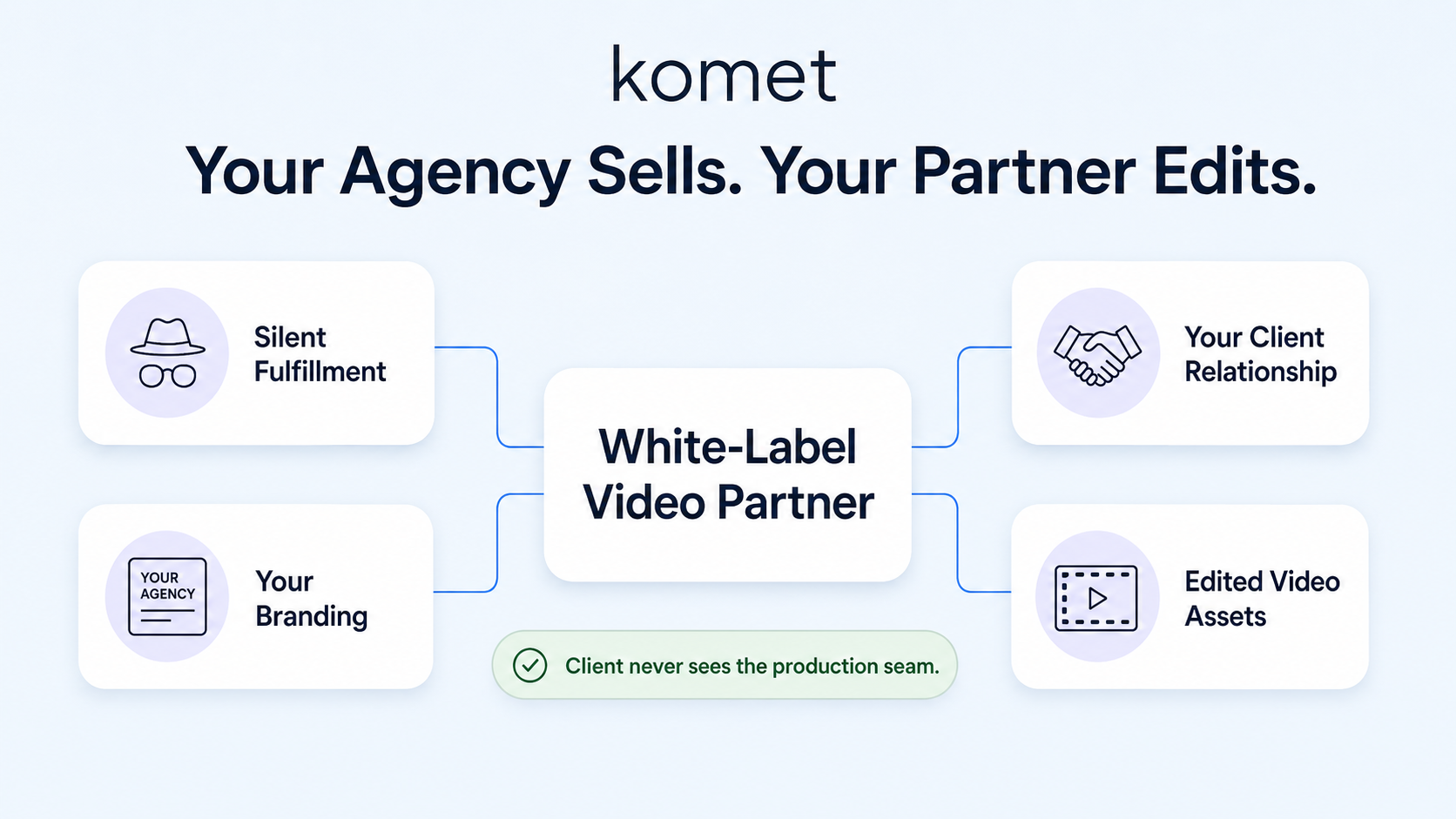
The output your partner produces typically includes:
- Short-form clips for Reels, TikTok content strategy, and YouTube Shorts
- Long-form edits repurposed from webinars, podcasts, or demos
- Branded content delivery with captions, motion graphics, and platform-specific formatting
- Ad variants for paid social campaigns
According to Wyzowl's 2025 Video Marketing Report, 91% of businesses now use video as a marketing tool , which means almost every client in your portfolio has a video need your agency can now serve. The model is straightforward: you scope, sell, and deliver. Your white-label partner does the edit.
Outsourcing vs. White-Label: What's the Actual Difference?
Most agency owners use these terms interchangeably. They're not the same, and conflating them costs you margin and control.
Outsourcing is a stopgap. White-label video editing for agencies is a revenue line. When you outsource, you're solving a production bottleneck. When you white-label, you're adding a billable video editing service to your agency's offer stack.
The key operational difference: with white-label, your client never sees the seam. Deliverables arrive under your brand, revisions flow through your account manager, and your client thinks your team produced every frame. That's what makes it a scalable branded content delivery system rather than a one-off fix.
How White-Label Video Editing Actually Works (Step by Step)
The workflow is simpler than most agency owners expect. Here's how a clean engagement runs:
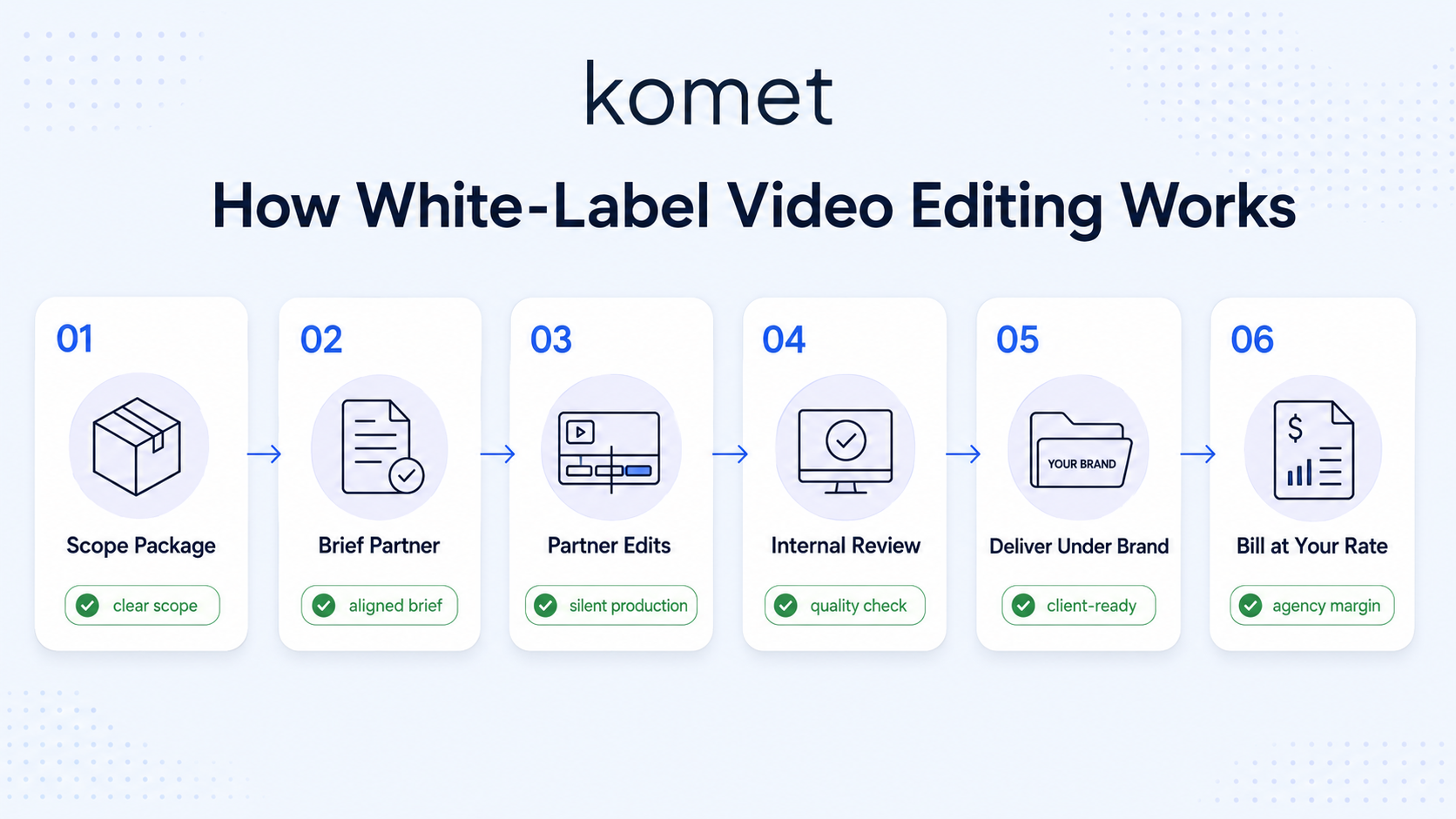
- Scope the package: Define what your client needs, volume (number of clips per month), formats (Reels, Shorts, long-form), turnaround time, and brand guidelines.
- Brief your fulfillment partner: Send raw footage, brand kit, captions preferences, music restrictions, and platform specs. A good partner has an intake form that covers all of this.
- Partner edits under NDA: The white-label team handles cuts, colour grading, captions, motion graphics, and platform formatting. No client contact, no brand exposure.
- You review internally: First-pass deliverables come to your account manager. You request revisions if needed before anything touches the client.
- Deliver under your brand: Files are sent to the client from your agency's accounts, with your agency's branding on all communications.
- Bill at your rate: You charge the client your retainer price. You pay your partner their wholesale rate. You keep the margin.
With the right partner, you can be operational in 1–2 weeks. The biggest setup delays come from agencies that skip the brief stage and send footage without brand guidelines. Lock that process down first.
At Komet Media, we build this intake layer for every partner engagement because a vague brief produces vague output, and your client relationship pays the price.
White-Label Video Editing Pricing Models for Agencies
Pricing is where most agencies leave money behind. There are three main structures:
- Partner charges: $1,500/month for 15 short-form clips
- Agency charges client: $3,000–$3,500/month
- Agency keeps: $1,500–$2,000/month per client, zero editing hours spent
If you manage 20 clients and even half need video editing at $2,000–$5,000/month, that's $20,000–$50,000 in monthly recurring revenue, with white-label margins of 40–100% keeping $8,000–$25,000 per month without hiring a single editor.
The retainer model wins for most agencies because it creates predictable revenue on both sides of the relationship. Clients stay on longer when video is embedded in their monthly package, and your partner can plan production capacity around your volume.
Bundled packages that include strategy, scripting, editing, and distribution increase average client value by 40–80% compared to selling editing as a standalone service.
What to Look For in a White-Label Video Editing Partner
This is where most agencies get burned. They choose a partner based on a portfolio reel and miss the operational signals that matter.
Evaluate every potential fulfillment partner against these criteria:
- Format range: Can they produce Reels production, YouTube Shorts, long-form edits, podcast clips, and ad variants? You don't want four different vendors.
- Turnaround SLA: What's the guaranteed first-draft delivery time? 48–72 hours is standard for short-form. Longer than five business days is a client relationship risk.
- Revision policy: How many rounds are included? Unlimited revisions without structure creates scope creep. Clear round limits protect everyone.
- NDA and brand confidentiality: Non-disclosure must be standard, not negotiable. Your client relationships are your most valuable asset.
- B2B content fluency: A partner who specializes in consumer lifestyle content will struggle with SaaS demos, founder interviews, and technical webinar repurposing. Relevant category experience matters.
- Dedicated account management: You need a single point of contact, not a ticketing queue. Async communication gaps kill turnaround times.
- Scalability: Can they absorb a 3x volume spike when you land a new client? Ask specifically.
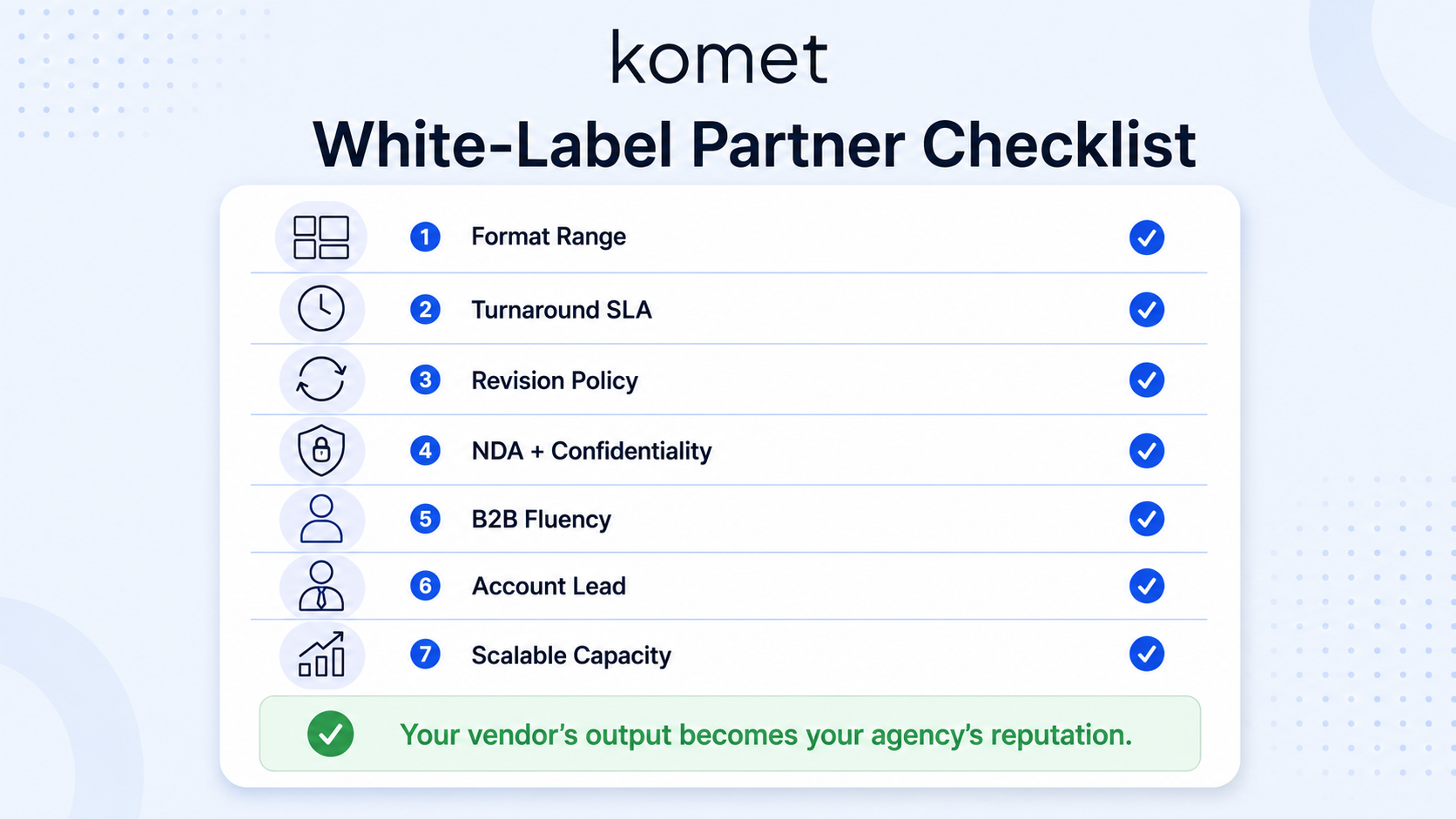
Short-form video has moved from a nice-to-have to a must-have in B2B marketing , which means the stakes for poor partner selection are higher than they were two years ago. A missed deadline or off-brand deliverable damages your agency's reputation, not your vendor's.
At Komet Media, our short-form video editing work is built specifically around B2B content: founder clips, webinar highlights, product demos, explainer videos and podcast-to-video conversions, the formats that actually move B2B pipeline. Explore our full services here.
How Agencies Scale Video Production Without Hiring In-House
Hiring a full-time editor sounds like the logical next step when video demand grows. The economics say otherwise.
A full-time video editor costs $55,000–$85,000/year in salary alone, and when you add software, equipment, and management overhead, you're looking at $80,000–$120,000 before that editor produces a single video.
White-label video editing for agencies sidesteps that entirely. The agency scalability play works like this:
- Client 1–3: Handle internally or with a light retainer. Validate that video is a sellable line item in your market.
- Client 4–8: Bring in a white-label partner on a shared retainer. Standardize your intake brief and delivery workflow.
- Client 9+: Negotiate a volume tier with your partner. Your cost-per-video drops. Your margin improves.
The constraint in most agencies is not editing skill, it's creative operations infrastructure. Intake forms, asset management, revision tracking, delivery naming conventions. These systems are what allow one account manager to oversee 10 active video clients without chaos.
78% of B2B marketers currently use video in their programs, and 56% plan to increase their video marketing investment within the next year , according to the 2025 B2B Marketing Benchmark Report from LinkedIn and Ipsos. That pipeline of demand is already inside your client base. The question is whether your agency captures it or watches a competitor do so.
Almost half of B2B marketers say short-form social video content delivers the highest ROI, which means your clients are being told by their own data that they need more of it.
The agencies that scale fastest treat their white-label partner as infrastructure, not a vendor. They standardize deliverable specs, build templated briefs, and create a repeatable video marketing system that runs at volume without heroics.
Can Small Agencies Afford White-Label Video Editing Services?
Yes, and in most cases, the math is inverted. Small agencies often can't afford not to offer it. The objection I hear most: "We don't have enough volume yet to justify a retainer." That's backwards. The retainer creates the volume by giving you something to sell.
Consider a three-client scenario:
The per-unit cost drops as volume grows. With three clients, you're already profitable. At eight clients, white-label video editing for agencies becomes one of the highest-margin services on your roster.
For most agencies under $500K in revenue, hiring an in-house editor doesn't work financially. White labeling flips the equation.
For small agencies especially, the right entry point is a per-video or low-commitment monthly plan that lets you test the model with one or two clients before scaling. Many fulfillment partners, including our team at Komet Media, will work with agencies at early volume because the relationship scales with you.
If you're a small agency evaluating whether to hire a dedicated video editor versus white-labeling, run the math on 12 months of fully-loaded employment cost versus a per-video partnership. The decision usually becomes obvious.
Conclusion
White-label video editing for agencies is one of the cleanest ways to expand your service offering, protect your margins, and deliver consistent video output without scaling headcount.
Key takeaways:
- White-label is structural, not transactional, treat your fulfillment partner as part of your creative operations.
- Pricing on retainer protects both sides and creates predictable revenue that scales.
- Partner selection criteria matter more than portfolio aesthetics, SLAs, NDA, and B2B fluency are non-negotiable.
- The economics work at any agency size, including early-stage shops with just two or three video clients.
If you want to see how Komet Media approaches white-label partnerships, contact us here or explore our full service offering.
Frequently Asked Questions
Q1: What is white-label video editing for agencies?
It's a model where a third-party production partner edits video content that your agency delivers to clients under your own brand. The partner remains invisible. You control pricing, client communication, and deliverable presentation, your client never knows who did the editing.
Q2: How is white-label video editing different from outsourcing?
Outsourcing is reactive and project-based. White-label video editing for agencies is a permanent, branded layer of your service stack. The partner works under NDA, delivers under your brand, and operates as a silent extension of your creative team rather than a one-off contractor.
Q3: How much do agencies typically mark up white-label video editing?
Most agencies mark up 50–100% over their partner's wholesale rate. On a retainer that costs $1,500/month from a partner, you might bill your client $2,800–$3,200 and keep the difference as pure agency margin.
Q4: What formats should a white-label video editing partner cover?
At minimum: short-form clips for Instagram Reels and YouTube Shorts, long-form edits from webinars or podcasts, TikTok-ready vertical video, and captioned social cuts. Partners specializing in B2B content should also handle demo repurposing and founder interview clips.
Q5: How do I pitch video editing to existing clients as a new agency service?
Frame it around outcomes, not production. Lead with pipeline impact, buyer education, and social visibility. Offer a pilot: one month of video content included in their existing retainer to demonstrate ROI before upselling a dedicated video package.
Q6: Can a small agency with fewer than 10 clients realistically use white-label video editing?
Yes. Most partners offer per-video pricing that scales with your volume. Starting with two or three clients on a modest clip volume generates immediate margin. The model becomes more profitable, not less, as you add clients, because per-unit costs drop with volume.