
🪄 AI Summary
Heading 1
Heading 2
Heading 3
Heading 4
Heading 5
Heading 6
Lorem ipsum dolor sit amet, consectetur adipiscing elit, sed do eiusmod tempor incididunt ut labore et dolore magna aliqua. Ut enim ad minim veniam, quis nostrud exercitation ullamco laboris nisi ut aliquip ex ea commodo consequat. Duis aute irure dolor in reprehenderit in voluptate velit esse cillum dolore eu fugiat nulla pariatur.
Block quote
Ordered list
- Item 1
- Item 2
- Item 3
Unordered list
- Item A
- Item B
- Item C
Bold text
Emphasis
Superscript
Subscript
You've got the perspective, the hard-won product insight, the founder story that should resonate with every buyer in your pipeline. But the posts land flat, the impressions stall, and the content that should be building trust is sitting invisible in a crowded feed. This guide breaks down exactly why founder POV content gets buried and how to surface it, using the mechanics of the 2026 LinkedIn algorithm, a smarter distribution stack, and a content repurposing framework designed for serious B2B SaaS teams.
TL;DR
- The LinkedIn algorithm now buries generic, low-dwell content and actively rewards topic consistency and engagement depth.
- Founder-led content outperforms brand pages by a wide margin, but only when it's distributed with intent.
- Short-form video, document carousels, and seed audience activation are your fastest surface-area levers.
- A content repurposing framework turns one founder insight into a multi-platform pipeline asset.
Why Founder POV Content Gets Buried: The Algorithm Is the First Problem
LinkedIn cut organic reach by roughly 50% in 2025. Follower growth dropped by 42%, and engagement rates fell across the board. That's not bad luck. That's a structural shift, and most founder content strategies haven't adapted.
LinkedIn's new Depth Score has replaced vanity engagement metrics as the primary distribution signal. The algorithm now evaluates how long users spend with your content, not just whether they tapped a reaction button. If your post gets scrolled past in three seconds, it loses reach fast. If you're a B2B SaaS founder, the algorithm expects you to share deep, authoritative insights about software growth, customer acquisition, or leadership. If you suddenly post a generic motivational quote or a completely unrelated piece of content, the algorithm flags it as low-relevance and suppresses its reach.
There's also the structural disadvantage of posting from the wrong place. Company pages now receive approximately 5% of user feed allocation while personal profiles dominate at around 65%. Organic reach on company pages has declined significantly between 2024 and 2026, a structural realignment rather than a temporary fluctuation. LinkedIn's new AI is now smart enough to detect AI-generated content, and it's not rewarding it. If your social strategy has been leaning on AI tools to crank out LinkedIn posts, you've probably noticed the drop already.
The summary: the algorithm rewards human presence, topic specificity, and genuine dwell time. Founder content that's generic, off-topic, or AI-templated is getting buried by design.
Why Your Startup Founder Content Is Getting No Traction (It's a Distribution Problem, Not a Quality Problem)
Most founders I work with aren't creating bad content. They're creating content without a distribution system behind it. The challenge for most founders is not publishing. The challenge is publishing content that earns attention from the right people and keeps circulating beyond the first hour. A post with 20,000 impressions from the wrong audience can be less useful than a post with 1,200 impressions from buyers, investors, future hires, or credible peers.
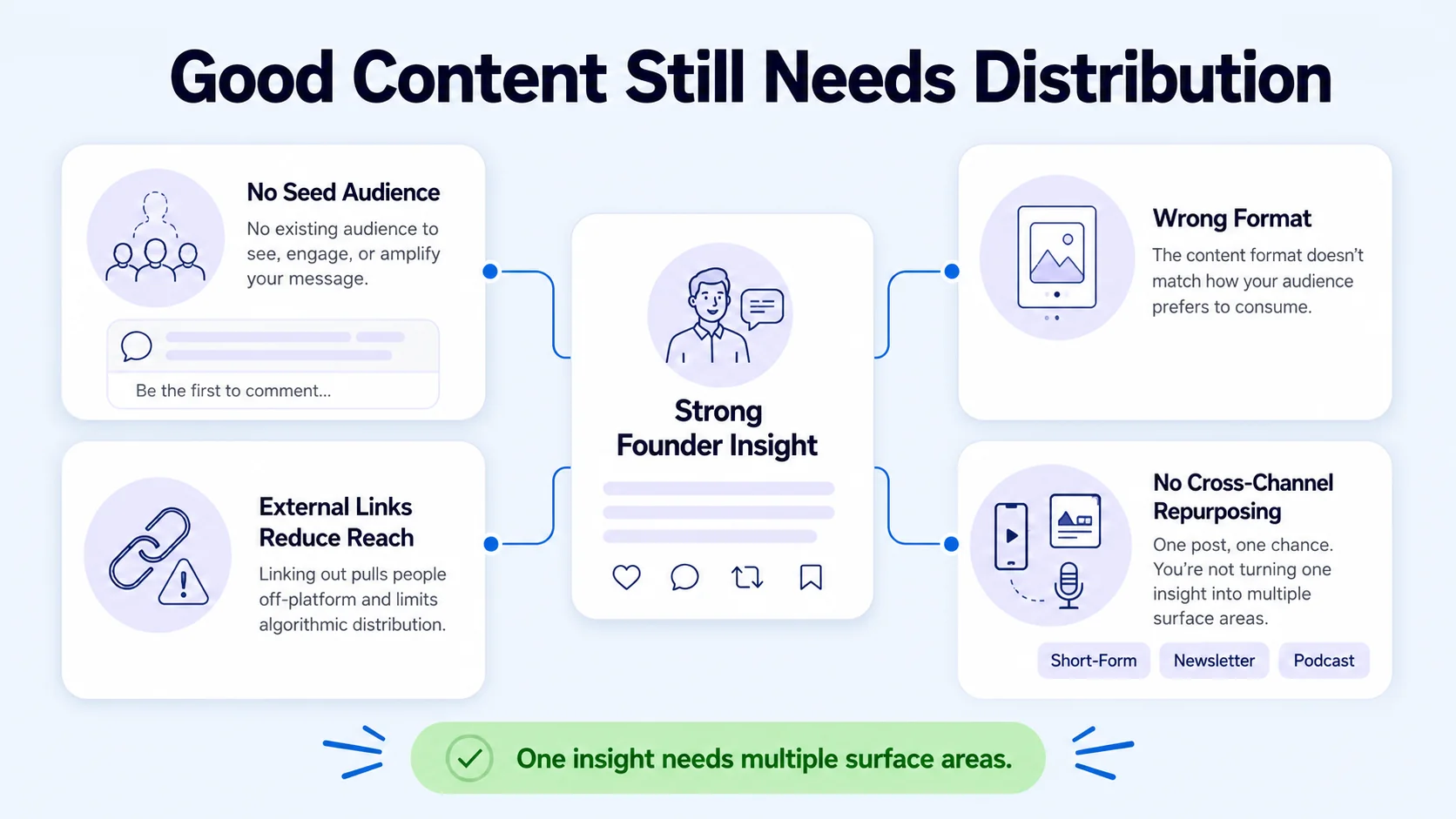
Here's what weak distribution looks like in practice:
- No seed audience activation: You post, then wait. Nobody comments in the first 30 minutes, so the algorithm doesn't expand distribution beyond your immediate first-degree network.
- Wrong format for your goal: Text-only posts from personal profiles are getting suppressed. Document posts (PDF carousels) are hitting 6.60% engagement rates, the highest of any LinkedIn format. Meanwhile, standard text posts struggle to break 2%.
- External links killing reach: Posts with links to external websites see approximately 60% less reach than identical posts without links. Dropping your blog URL in the caption is actively punishing your distribution.
- No cross-channel repurposing: One LinkedIn post is one roll of the dice. A content repurposing framework turns that same founder insight into a short video clip, a carousel, a newsletter section, and a podcast talking point.
Founder-led content consistently outperforms corporate content on reach, engagement, and qualified pipeline attribution. But that outperformance only materialises when distribution is built around the content, not bolted on after the fact.
How the LinkedIn Algorithm Buries Founder Opinion Posts (and What It Rewards Instead)
The algorithm evaluates content through three sequential phases. First, a quality classifier assesses the post within minutes of publication, examining content substance, formatting signals, and author credibility. Second, early engagement patterns within the first 30 minutes determine initial distribution scope. Third, the Depth Score accumulates over the following 24-48 hours and can either expand or contract distribution based on how deeply the audience actually engages.
What this means for founder POV content: you have a narrow window to generate real engagement velocity before the algorithm decides your content is low-value. Dwell time is the most powerful signal in 2026. A post read for at least 15 seconds receives an estimated 40% reach bonus. Posts that hook users in the first three visible lines before "see more" mechanically get more distribution.
Engagement bait triggers active suppression. Tactics like "Comment YES if you agree" and reaction polling are now detected and penalised. LinkedIn's AI systems detect reciprocal engagement patterns and apply shadowbans without warning.
In 2026, the lifespan of a highly successful LinkedIn post has actually increased. While low-quality posts die in 90 minutes, a post that reaches Stage 4 can continue to accumulate views for up to two weeks, acting as a long-term asset for your personal brand.
Best Practices for Founder Content That Gets Seen: A Practical Framework
The fix for buried founder content is a system, not a one-off tactic. At Komet Media, we build this as a five-step content repurposing framework for B2B SaaS founders:
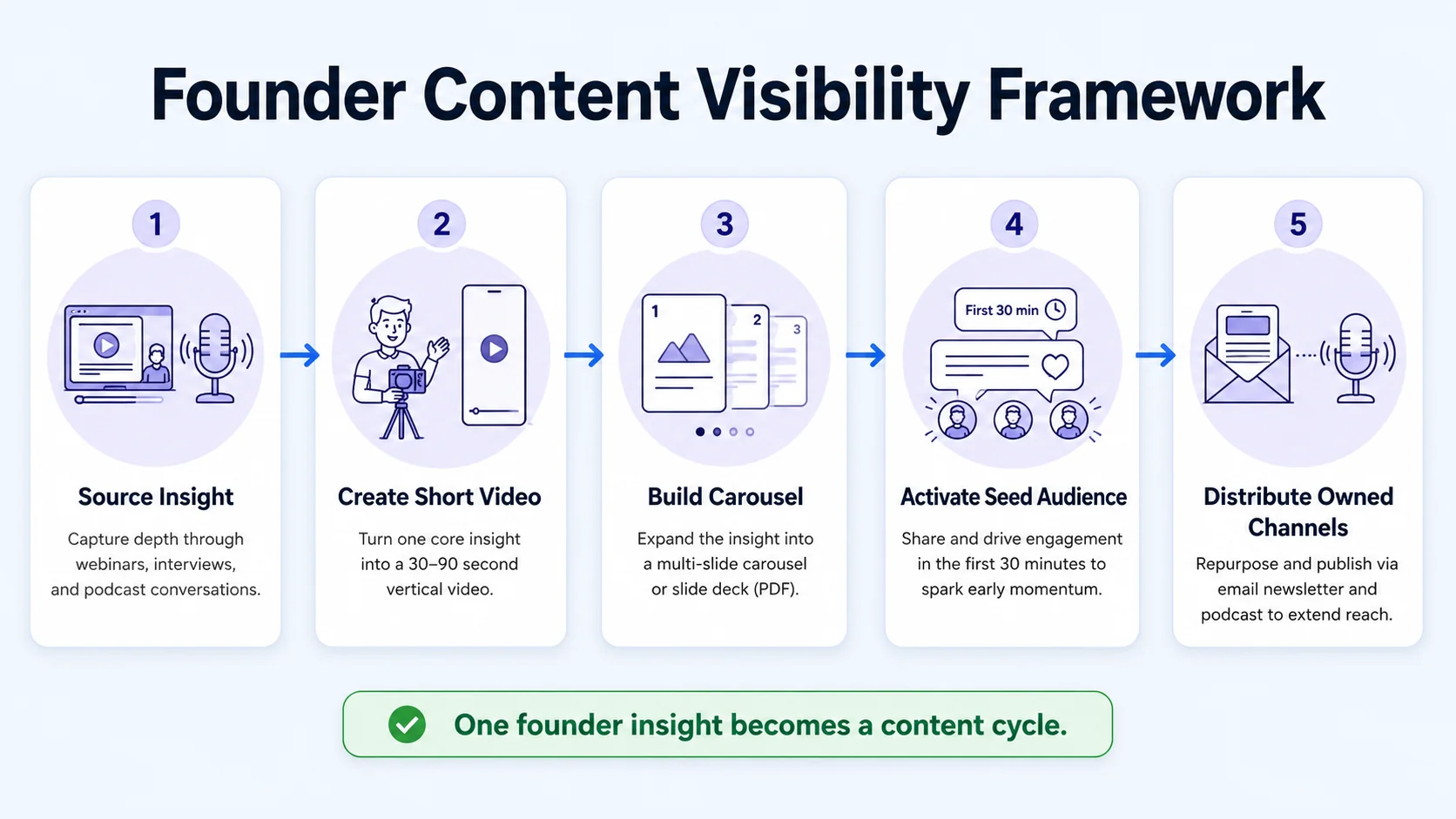
- Source the insight from existing long-form: Pull the sharpest founder POV from a webinar, podcast, demo recording, or internal strategy call. The insight already exists. Extract it.
- Build the short-form video first: A 60-to-90-second native video clip on LinkedIn anchors the content cycle. Video receives a performance boost, especially when branding appears in the first few seconds. Videos under 30 seconds achieve substantially higher completion rates than longer formats.
- Convert to a document carousel: Take the same idea and build a 6-to-8-slide PDF carousel. This is your highest-engagement format. Average reach for carousel posts is 3-5x higher than text-only posts from the same accounts. Users spend 30-60 seconds on carousels versus 3-5 seconds on text posts.
- Activate your seed audience in the first 30 minutes: Brief 3-to-5 people in your network (team members, peers, customers) to comment substantively within the first half hour. Real comments with relevant context signal quality to the algorithm.
- Distribute across owned channels: Send the insight to your email list, use it as a podcast episode talking point, and clip it for a short-form video series. One insight, multiple surface areas.
Topic consistency matters because LinkedIn needs to know what you should be known for. Running this framework around 3-to-4 content pillars tied directly to your product positioning builds topical authority that compounds over time.
How to Get Founder Voice Content to Rank in AI Search
The 2026 distribution challenge is no longer only about the LinkedIn algorithm. A growing share of B2B purchase research now begins with an AI query. Buyers use Perplexity, ChatGPT, and Google AI Overviews as their first step in gathering information for complex purchases. Companies that appear in those AI-generated answers are earning discovery before a single search result is clicked.
Getting your founder POV content surfaced in AI search requires a different set of signals than traditional SEO:
- Structured, quotable opinions: AI engines extract direct, clearly framed POV statements. Write in clear declarative sentences. "Most SaaS onboarding fails because it optimises for activation, not outcome" is indexable. "There are many approaches to onboarding" is not.
- Distributed citations across platforms: When the same founder perspective appears in a LinkedIn post, a podcast episode, a video clip, and a blog article, AI engines weight it as a consensus signal.
- Native platform content over links: Content that lives natively on LinkedIn rather than pointing to an external blog gets processed by the platform's own AI. The 2026 algorithm now utilizes advanced Large Language Models to evaluate content. Instead of simply counting passive likes, the system prioritizes deep consumption rate, saves, and shares.
- Earned citations from third-party sources: Original data gets cited more than any other content type, by journalists, industry analysts, and AI engines. If you can conduct and publish a survey, benchmark, or study relevant to your category, every media pick-up becomes a high-authority citation in your profile.
Knowledge Graph Optimization for founders means owning a clear, consistent topic cluster. Post about one space repeatedly, from one profile, with a consistent perspective. The algorithm and the AI both reward specificity over breadth.
How to Make Your Founder Story Reach More People: The Content Distribution Stack
Posting is not distributing. A content distribution stack means every piece of founder content has multiple amplification routes built in before it goes live.
Here's the stack that works for B2B SaaS founders in 2026:
The brands seeing the most organic success in 2026 are the ones empowering founders, leaders, and employees to be visible while the company page supports from the background. Content shared by CEOs receives 4x more engagement, and employees drive 30% of company engagement. This means your team is part of the distribution stack. Employee advocacy on founder posts within the first 30 minutes directly shapes algorithmic reach.
LinkedIn in 2025 rewards personal storytelling from founders more than ever, but not one-off stories. Story arcs that unfold over multiple posts perform significantly better. Story arc posts average 2.3x the reach of standalone story posts from the same accounts.
For B2B SaaS teams specifically, the video marketing layer is where most of the untapped surface area lives. Product knowledge, demo walkthroughs, and founder thinking that currently sit in long-form recordings can be extracted, edited, and turned into platform-native clips that educate buyers at every stage of evaluation.
Conclusion
Why founder POV content gets buried comes down to three compounding failures: the wrong distribution system, the wrong formats, and no seed audience activation. Here's what to take away:
- Post from the founder's personal profile, not the company page. Personal profiles generate up to 70% more organic reach.
- Build a content repurposing framework that extracts one insight and distributes it across short video, carousels, podcasts, and email.
- Activate your seed audience in the first 30 minutes, every time. Early engagement velocity determines algorithmic reach.
- Own a specific topic cluster consistently. Topical authority building is how you win both the LinkedIn algorithm and AI search visibility.
The insight is already there. The system to surface it is what most founders are missing. Get in touch with Komet Media to build that system.
Frequently Asked Questions
Q1: Why does my founder content get engagement but no pipeline?
Engagement without a pipeline usually means your content is reaching the wrong audience or lacks a clear next step. Optimise for saves and substantive comments from your ICP, not broad reactions. Layer in soft CTAs that move buyers toward a demo or conversation, not just a like.
Q2: How often should a founder post on LinkedIn to build visibility?
Posting 3 to 5 times per week, replying with substance, and tracking saves, qualified comments, profile views, and inbound leads is the baseline that consistently compounds. Consistency beats volume. Three intentional posts beat seven rushed ones every week.
Q3: Does short-form video actually work for B2B SaaS founders?
Yes. Native video on LinkedIn gets an algorithmic boost, especially under 30 seconds with captions. For B2B SaaS specifically, short video is the fastest format to demonstrate product thinking and founder credibility to buyers who are evaluating you before they ever book a demo.
Q4: Why is my LinkedIn reach dropping even though I post consistently?
The algorithm rewards depth, expertise, and topic consistency over posting volume and engagement hacks. If your content is generic, AI-generated, or off-topic from your established expertise, consistency alone won't recover reach. Audit your last 10 posts for specificity and dwell-time potential.
Q5: How do I get my founder's content picked up by AI search tools like Perplexity or ChatGPT?
Structured, quotable POV statements distributed consistently across platforms (LinkedIn, podcast, video clips, blog) create the citation signals AI engines use. Earning third-party mentions in publications or research round-ups accelerates this significantly.
Q6: What's the fastest way to start a content repurposing framework if we have no existing content?
Start with a webinar or an internal Q&A session recorded on video. Extract the 3-to-5 sharpest answers the founder gives. Turn each into a short video clip, a carousel slide, and a LinkedIn text post. That's your first content batch, and it takes one hour of founder time to source.