
How to Start a Podcast on Youtube: A Guide for Founders & CEOs: Step-by-Step Guide
Most founders know they should be creating content. Few act on it with the precision it deserves. If you're trying to build trust with buyers, shorten your sales cycle, and own a distribution channel your competitors don't, learning how to start a podcast on YouTube is one of the highest-leverage moves you can make in 2026. This guide gives you the exact setup, structure, launch sequence, and growth system, built specifically for B2B founders and executive teams who need results, not a hobby project.
TL;DR
- YouTube is the #1 podcast platform: YouTube captures 33% of weekly US podcast listeners, ahead of Spotify at 26% and Apple Podcasts at 15%.
- Video podcasts surface in YouTube Search, generate short-form clips, and build buyer trust faster than blogs or audio alone.
- You need three things to launch: the right gear, a podcast hosting platform connected to an RSS feed, and a consistent publishing system.
- Content repurposing from each episode multiplies your reach without multiplying your effort.
Why YouTube Is the Right Home for Your B2B Podcast
Most founders still think of podcasting as an audio-first medium. That mental model is outdated. Video podcasts are no longer a niche, 51% of Americans age 12+ have now watched a podcast, and 73% have consumed a podcast in audio and/or video format. YouTube is now the most used platform for podcast consumption.
For a B2B founder trying to build authority, that matters enormously, because YouTube is also a search engine. When a prospective buyer searches for problems your product solves, a well-optimized video podcast episode can surface directly in their results. Audio-only shows cannot do that. Video podcasts outperform audio-only shows because they appear in YouTube search results, generate shareable clips, and signal brand credibility to first-time viewers.
That credibility signal is the core of founder-led growth: buyers see your face, hear your thinking, and arrive at your demo already warm. As many as 53% of US podcast listeners now opt for watchable podcasts , and video podcasting on YouTube is growing 35% faster than audio-only. The window to establish a category-defining show in your niche is still open, but it narrows every quarter.
For B2B SaaS and AI/tech teams specifically, a video podcast does four jobs at once:
- Educates buyers on the problem your product solves (buyer education)
- Positions the founder as the category expert (thought leadership and personal branding)
- Generates short-form clips for paid and organic distribution (inbound demand)
- Gives your sales team credible assets to share mid-deal (sales enablement)
No other single content format does all four. That's why I recommend it to every serious B2B team at Komet Media before anything else. Whether you are repurposing existing archives or starting from scratch, Komet provides end-to-end production support—from niche strategy and scripting to recording guidance—to ensure your show builds immediate authority.
What Equipment Do You Need to Start a YouTube Podcast?
You don't need a broadcast studio. You need a setup that makes you look and sound credible. Here's what that means in practice.
Audio is non-negotiable. Viewers will tolerate average video, but they will click away from bad audio within seconds. The best podcast microphones, like the hybrid Shure MV7+ or the iconic Shure SM7B, focus heavily on your voice while naturally blocking out background noise and room echo. For a founder just starting out, the Shure MV7+ (USB/XLR hybrid) is the right call: plug-and-play simplicity with a path to upgrade.
Camera comes second, but lighting comes first. Lighting matters most, a well-lit shot with a webcam looks more professional than a poorly lit shot with a $1,500 camcorder. Once you have controlled light, the best all-around video camera for podcasting is a mirrorless or compact camera in the $500–$1,000 range, the Sony ZV-1 II and Canon EOS R10 both perform well across studio recording, on-location interviews, and YouTube uploads.
Recording and production software depends on your workflow:
Starter gear checklist:
- Dynamic USB/XLR microphone (Shure MV7+ or Rode PodMic)
- Key light or ring light (positioned in front of you, not behind)
- Camera at eye level (webcam, Sony ZV-1 II, or Canon EOS R10)
- Closed-back monitoring headphones
- Acoustic treatment (furniture, soft panels, or a closet works)
This setup runs $500–$1,200 all-in for a professional-looking solo show.
Step-by-Step Guide to Launching a Podcast on YouTube
This is the exact launch sequence I walk B2B clients through at Komet Media. Our full-cycle engagement handles every detail for teams without a content library, including technical setup, recording production support, and buyer-centric scripting.
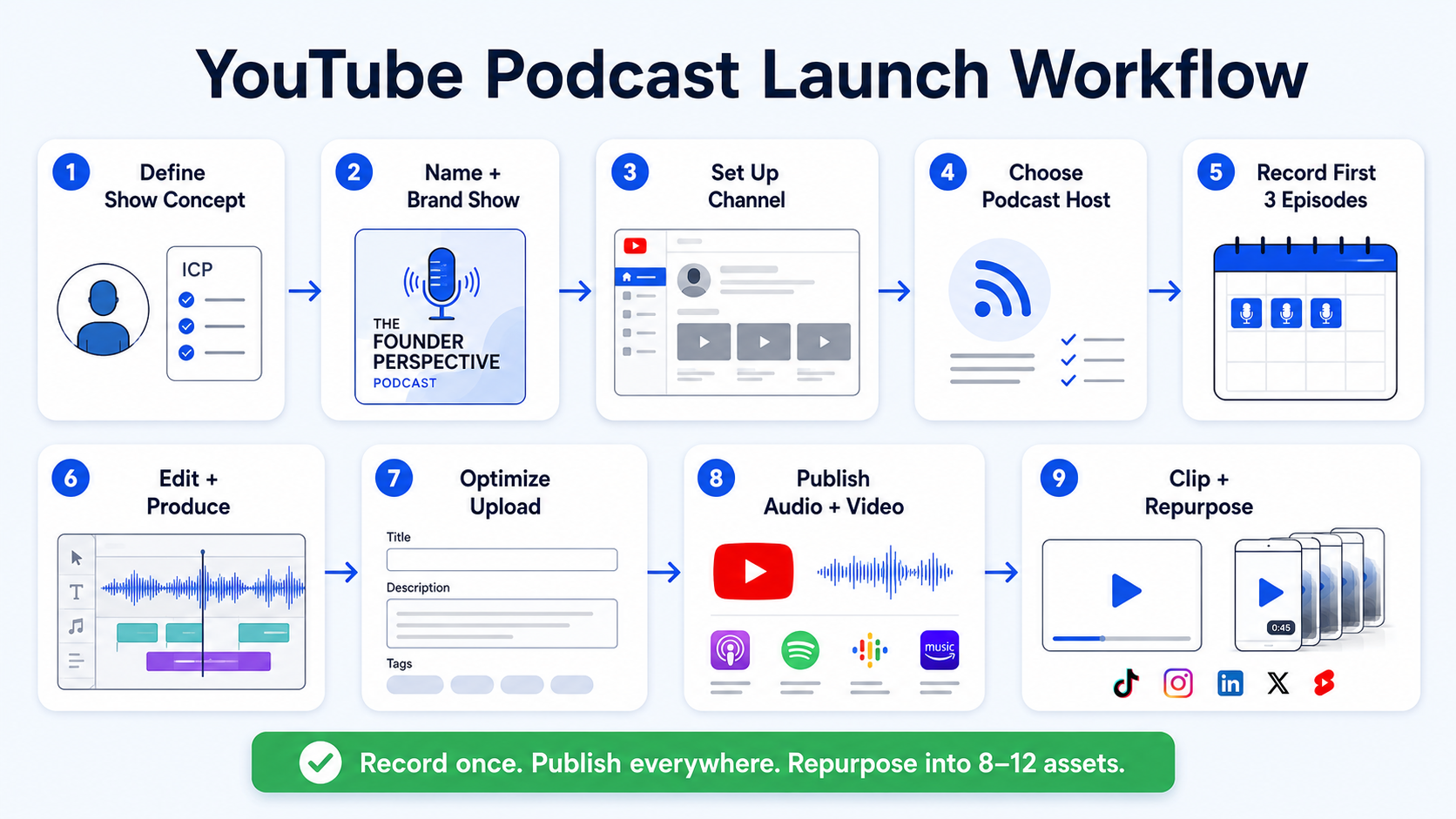
- Define your show concept: Pick one audience (your ICP), one topic territory (the problem you solve), and one format (solo, interview, or co-hosted). Specificity beats breadth every time.
- Name and brand the show: Choose a name that signals your niche, not just your company. Create a 1400×1400px podcast cover art in Canva, YouTube uses this as your channel thumbnail when the video isn't loaded.
- Set up your YouTube channel: Inside YouTube Studio, create a dedicated channel for the podcast. Fill out the channel description with your primary keyword phrases and link to your website. Enable monetization settings from day one even if you're not monetizing yet.
- Choose a podcast hosting platform: Use Buzzsprout, Spotify for Podcasters (Anchor), or RSS.com to host your audio files. This generates your RSS feed, which distributes the audio version to Spotify, Apple Podcasts, and every other directory automatically.
- Record your first three episodes before publishing: Batching your first three episodes protects you from the gap between episode one going live and episode two being ready. Consistency is the single biggest predictor of podcast survival.
- Edit and produce: Use Descript for transcript-based editing. Remove filler words, tighten pacing, and add your intro/outro. Export a full-length video file (1080p minimum, 4K preferred) for YouTube.
- Upload to YouTube with an optimized title, description, and tags: Your episode title is a headline. Your description is a show notes page with timestamps, links, and an episode transcript summary. Your tags should match the exact phrases your buyers search.
- Publish and distribute: Upload the audio file to your podcast hosting platform simultaneously so both YouTube and your RSS feed go live together.
- Clip and repurpose: Pull 3–5 short-form clips (60–90 seconds) per episode for LinkedIn, Instagram Reels, and YouTube Shorts.
Every episode you record is a content asset. At Komet Media, we build repurposing systems so one 45-minute episode becomes 8–12 pieces of content. That's the multiplier most founders leave on the table.
YouTube Podcast vs Traditional Podcast: Which Wins for Business Leaders?
This question gets asked constantly. Here's the honest answer: for B2B founders and CEOs, YouTube video podcasting is almost always the stronger play. Here's why, compared side by side:
The only scenario where audio-only wins is when your audience primarily consumes content during commutes, and even then, publishing both formats covers that gap. With a podcast hosting platform and an RSS feed connected to your YouTube upload workflow, you can do both with the same recording.
Traditional audio-only podcast discovery relies almost entirely on existing directories and word of mouth. YouTube is now the #1 discovery platform for podcasts. For a founder who wants an inbound pipeline and not just listeners, that asymmetry decides the question.
How Founders Use Podcasting to Build Authority and Pipeline
This is where most podcast guides go wrong, they treat a podcast as a content project. I treat it as a pipeline asset. Here's how it works inside a B2B sales motion:
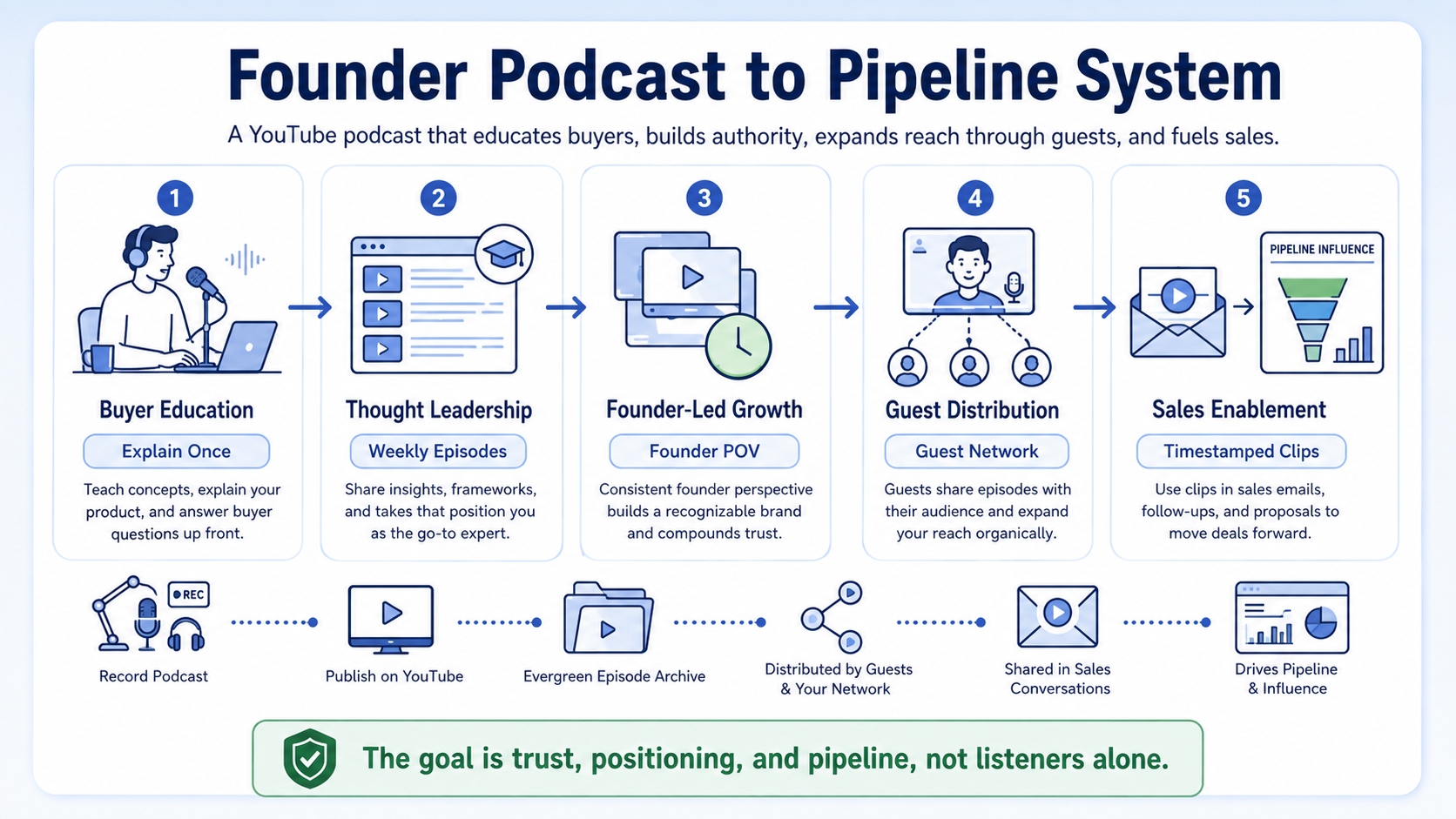
Buyer education at scale: Instead of your sales team explaining the same product concept 40 times per month on demo calls, a well-structured podcast episode does it once, and that recording works indefinitely. A prospect who's watched three episodes of your show before the first call already trusts your framework. That changes the entire sales dynamic.
Thought leadership that compounds: Episodes released weekly perform best for audience retention. Consistent publishing builds a compounding library of evergreen content, episodes from six months ago still rank, still surface in search, and still drive inbound. Unlike paid ads, the asset doesn't stop working when the budget stops.
Founder-led growth in practice: The founder's voice, point of view, and direct communication style is a competitive moat that no competitor can replicate. When your CEO is publishing a weekly video podcast on the exact problems your buyers face, you own the conversation in your category.
Guest strategy for distribution: Inviting relevant guests, customers, partners, analysts in your space, gives each episode a built-in distribution channel. Guests with existing audiences can boost downloads by 20–300%. Every guest shares the episode with their network, which means each episode markets itself.
Sales enablement assets: Every episode generates a shareable YouTube link, an episode transcript, and short-form clips. Your sales team can drop a specific timestamped clip into a prospect's inbox the morning of a demo call, a credibility signal that no competitor brochure can match.
At Komet Media, we build the full production and repurposing pipeline around exactly this motion. We partner with founders to develop the initial show concept and recording system, managing the entire process through to final distribution. The goal is never listeners for their own sake, it's pipeline, trust, and positioning.
How to Grow a YouTube Podcast as a Startup Founder
Recording great episodes is not the same as growing a show. Growth requires a deliberate distribution system.
Optimize every upload in YouTube Studio:
- Episode title: state the problem or outcome clearly, under 60 characters where possible
- Thumbnail: use your face, high contrast, and 2–4 words of text maximum
- Description: write full show notes with an episode transcript summary, timestamps, and links, this is what YouTube and Google index
- Chapters: add chapter markers to the video; this improves completion rates and makes the episode skimmable
Short-form is your primary growth engine: Clipped highlights drive up to 60% of new listener acquisition on TikTok and Shorts. Treat every 60–90 second clip as a standalone piece of content, not a preview. It should deliver a complete insight on its own.
Anchor text optimization for show notes: Link to your product pages, related episodes, and relevant resources inside every episode's show notes. This builds topical authority and drives referral traffic. Our podcast show notes service and podcast transcription service handle this automatically for clients who don't want to do it manually.
Republish audio everywhere: Use your podcast hosting platform to push every episode to Spotify, Apple Podcasts, and Amazon Music simultaneously. More distribution points means more discovery surface area.
Common mistakes founders make and how to avoid them:
- Launching without three episodes ready (audiences churn instantly if episode two isn't there)
- Treating the podcast as a brand awareness play with no conversion goal attached
- Publishing without show notes or an episode transcript (losing all the SEO value)
- Skipping short-form clips entirely (the biggest growth lever, consistently ignored)
- Starting strong and abandoning, 30% of all podcast shows have fewer than 10 episodes , which means the bar to "consistent" is genuinely low
Publish on a locked schedule. Podcasts with consistent posting schedules grow 3x faster than those that publish irregularly. Choose weekly or bi-weekly and protect that cadence.
Conclusion
- YouTube is the dominant platform for podcast discovery, and video podcasts grow 35% faster than audio-only shows.
- The right setup is achievable under $1,200: a quality dynamic microphone, controlled lighting, a mirrorless camera, and Riverside.fm or Descript for production.
- Content repurposing is the growth multiplier: one episode should yield clips, show notes, an episode transcript, and social assets.
- Pipeline, not vanity metrics: a B2B podcast earns its place by educating buyers, enabling sales, and compounding authority over time.
If you want a done-for-you production and repurposing system built around your show, see how Komet Media approaches podcast production for B2B teams.
Frequently Asked Questions
Q1: How long does it take to launch a YouTube podcast from scratch?
With equipment ready and a clear show concept, you can record, edit, and publish your first episode in a week. Most founders spend 2–3 weeks on setup, branding, and batching their first three episodes before going live. The prep time is well spent.
Q2: Do I need a separate podcast hosting platform if I'm already on YouTube?
Yes. YouTube hosts your video, but a podcast hosting platform like Buzzsprout or Spotify for Podcasters generates your RSS feed and distributes the audio version to every other directory automatically. Running both gives you maximum reach with one recording.
Q3: How often should a founder publish a new podcast episode?
Weekly is the gold standard for growth. Bi-weekly works if production bandwidth is limited. Anything less than bi-weekly makes it hard to build audience momentum and compound the SEO and algorithmic benefits YouTube's system rewards.
Q4: Can I start a YouTube podcast without showing my face on camera?
Yes, but it significantly limits your growth potential. Screen-share formats and slides-with-voiceover work for some technical niches. For founder-led B2B content, showing your face builds the personal trust that accelerates buyer confidence and supports your sales motion.
Q5: What tools do I need to repurpose podcast episodes into short-form content?
Descript handles transcript-based editing and clip creation. Canva produces audiograms and branded thumbnails. Riverside.fm records studio-quality remote interviews. These three tools cover the full repurposing workflow for most B2B teams. Our short-form video editing service manages this end-to-end if you'd rather not handle production in-house.
Q6: How do I measure whether my YouTube podcast is actually generating pipeline?
Track UTM-tagged links in your show notes, monitor how many demo requests mention the podcast in discovery calls, and watch for spikes in direct traffic after new episodes. YouTube Studio also shows impressions, click-through rate, and average view duration, all signals of content quality and audience fit.

