
What a B2B Video Marketing Engagement Looks Like: Step-by-Step Guide
Most SaaS founders and marketing heads I work with track views. Views are not B2B video marketing engagement. Engagement is the signal that a decision-maker moved, watched longer, clicked deeper, shared with a colleague, or booked a demo. In B2B, that distinction is the difference between content that fills a dashboard and content that fills a pipeline. This guide breaks down exactly what B2B video marketing engagement means, how to measure it, what good looks like, and how to build a system that actually moves buyers.
TL;DR
- B2B video marketing engagement measures buyer intent signals, watch time, click-through, shares, and pipeline influence, not just view count.
- Good B2B engagement benchmarks differ sharply from B2C because purchase cycles are longer and decisions are made by committees.
- LinkedIn is now the primary distribution channel, with video posts outperforming text by a measurable margin.
- Short-form video (60–90 seconds) drives the highest ROI for B2B teams right now.
What Does B2B Video Marketing Engagement Mean?
Engagement in B2B video is not a single metric. It is a cluster of behavioral signals that tell you whether a buyer is paying attention, and whether that attention is converting into pipeline movement. Views and impressions measure distribution. Engagement measures response. The gap between those two things is where most SaaS marketing teams leak budget.
In practice, B2B video marketing engagement covers four layers:
- Attention signals: watch time, percentage viewed, quartile completions (25%, 50%, 75%, 100%)
- Action signals: click-through rate (CTR) on CTAs embedded in or attached to the video
- Social signals: shares, saves, comments, especially DM shares on LinkedIn
- Pipeline signals: video-influenced MQLs, CRM touchpoints attributed to video, demo requests following video views
For B2B marketers, vanity metrics like views are insufficient. The primary goal is to connect video performance to tangible business outcomes, which requires tracking metrics that bridge the gap between audience engagement and sales activity.
The buyer journey context matters here. B2B buyers rarely watch one video and immediately request a demo. The average B2B video viewer watches 3.2 videos per session when researching solutions for their business needs. That multi-video session is your opportunity, engagement tracking across that sequence tells you exactly where buyer conviction forms and where it breaks.
Tools like Vidyard and Wistia give you viewer-level data tied to known contacts, which means you can fire a sales alert when a named account watches 80% of your product demo. That is B2B video marketing engagement working at full depth.
B2B video engagement measurement requires a multi-metric approach: track view count, watch time, average view duration, and audience retention rate for engagement depth; monitor click-through rates, form completions, and content downloads for action metrics; and connect video views to CRM data for pipeline influence and revenue attribution.
The short version: if you cannot draw a line from a video view to a pipeline stage, you are measuring attention, not engagement.
How Is B2B Video Engagement Different from B2C?
The core difference is decision architecture. B2C buyers decide individually, often emotionally, and quickly. B2B buyers involve multiple stakeholders, evaluate over weeks or months, and need to justify the purchase internally.
That changes everything about what engagement looks like and what it signals.
The metrics that matter most shift significantly based on whether you sell to businesses or consumers, and longer videos actually perform better in B2B because audiences will watch detailed product demos and educational content if the information is valuable. 78% of B2C marketers prioritize emotional storytelling in videos, compared to just 42% of B2B marketers.
B2B video has to earn its watch time by delivering information that helps a buyer build an internal business case, not just feel good about a brand. B2B companies see 24% higher engagement from LinkedIn video content than B2C brands on the same platform, which reflects the professional intent baked into LinkedIn's audience. B2C social virality simply does not translate. B2B video marketing engagement is slower, deeper, and far more tied to pipeline than to reach.
What Metrics Actually Matter for B2B Video Marketing?
Tracking the right metrics separates teams generating pipelines from teams generating reports. The metrics that genuinely matter, grouped by what they tell you:
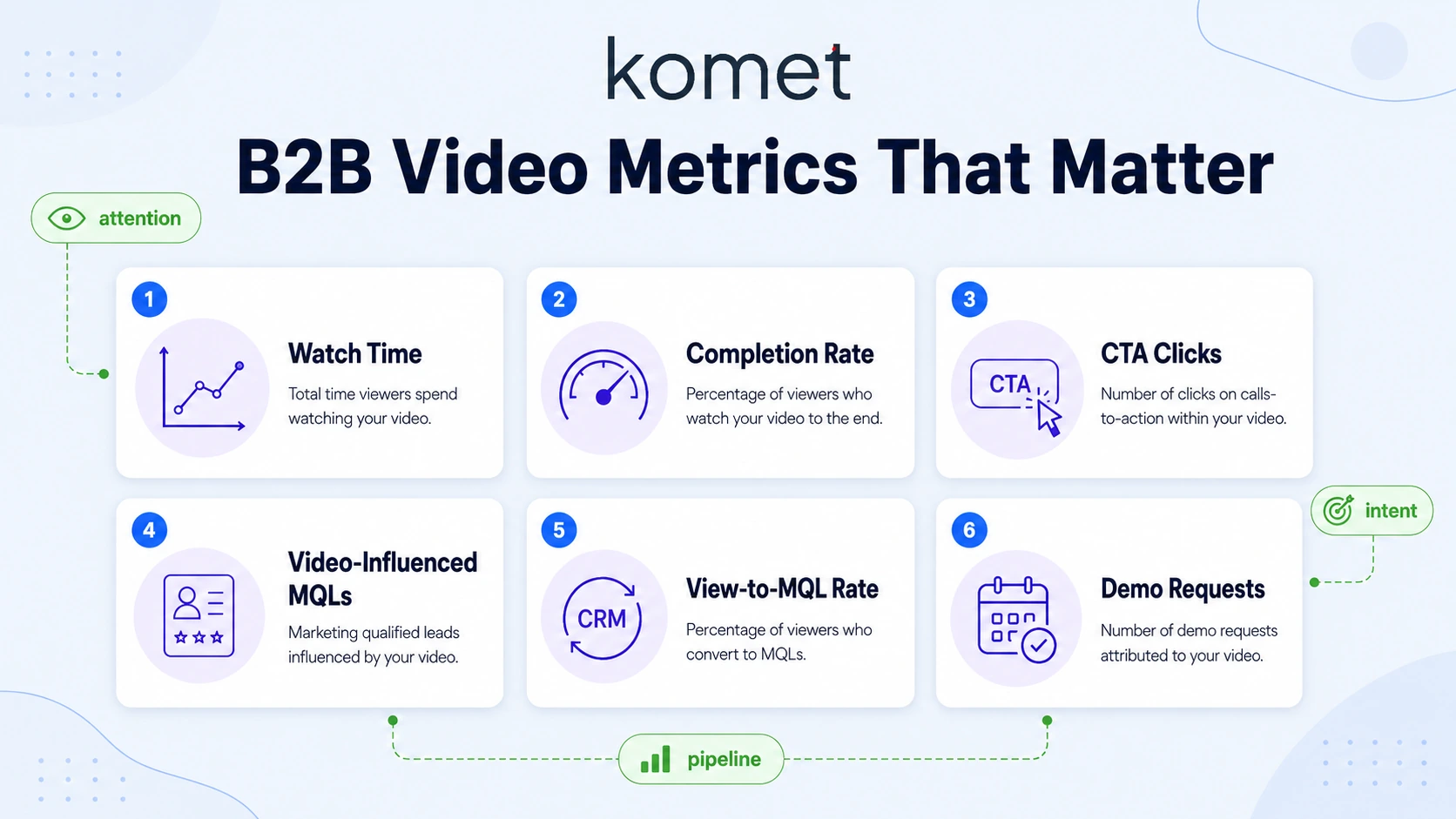
Depth of attention (engagement quality)
- Average watch time and percentage viewed per video
- Quartile completions, track where viewers drop off; if the majority leave before 50%, your core message is buried
- Videos under one minute achieve around 65% average engagement according to Wistia benchmark data , making completion rate a reliable gauge for shorter assets
Pipeline signal (engagement value)
- Pipeline-influenced video is a key B2B metric, B2B companies report that video influences over 40% of their sales pipeline on average, according to Demand Gen Report data.
- View-to-MQL conversion rate, how many viewers of a specific asset (webinar, demo video) became marketing-qualified leads
- B2B organizations using video report 27% higher MQL rates than those that don't.
Platform-level signals (distribution quality)
- Unique views over total views, unique views reveal true audience reach without inflating repeat plays
- Click-through rate on in-video or below-video CTAs
- LinkedIn video ads earn 30% more comments per impression than image ads , making comment volume a platform-specific signal worth tracking
Conversion rate optimisation signals
- Website conversion rates increase from 2.9% to 4.8% with video, landing page CTR before and after adding video is a clean test of video's contribution to conversion rate optimisation
- Demo request rate following video touchpoints in your marketing funnel
Watch time is the honesty metric. Views can be gamed by distribution budget. Watch time tells you whether the content was worth the viewer's time, and in B2B, that time is expensive.
What Does Good Engagement Look Like for B2B Video Content?
"Good engagement" is context-dependent. A 45% completion rate on a 10-minute product walkthrough is strong. A 45% completion rate on a 60-second LinkedIn clip is a problem.
Here is what realistic good engagement looks like in 2026, by format:
According to ON24's 2025 Webinar Benchmarks Report, the average webinar achieves a 57% registration-to-attendance conversion rate, a useful anchor for live video formats. B2B videos under 90 seconds retain 50% more viewers than longer formats, which means short-form is not just an awareness play, it is the engagement floor every B2B team needs to clear before investing in longer assets.
73% of B2B decision-makers prefer to watch product demo videos rather than read whitepapers or brochures , which signals that demos are not a "nice to have", they are the primary persuasion format for this audience. Good engagement also means the right buyers are watching, not just the most buyers. A product demo watched by 200 people matching your ICP outperforms a viral clip viewed 20,000 times by people who will never buy.
What Types of Videos Get the Most Engagement in B2B?
Not all formats perform equally. Based on current 2025–2026 data, four video types consistently outperform on engagement in B2B:
- Educational and how-to videos: Teach the buyer something they can use before they even consider your product. Tutorial videos receive 53% higher average watch time than promotional videos across most platforms. For SaaS teams, this means product education content that solves a real workflow problem drives deeper watch time than feature announcements.
- Product demos: Product demo videos lead to a 46% increase in purchase intent compared to non-video product pages. Decision-makers watching demos are already in evaluation mode, completion rate here directly predicts pipeline readiness.
- Webinars (live and on-demand): On-demand webinars keep getting played for up to 12 months after the live event, and educational videos, product videos, social videos, and webinars are the four formats where B2B teams are investing and doubling down. At Komet Media, our webinar repurposing workflow turns a single live session into 10–15 short-form clips that run as evergreen demand gen content.
- Customer testimonials and case studies: Customer testimonial videos increase trust levels for 62% of viewers, while written testimonials impact only 34%. In B2B, social proof is a buying criterion, not just a nice signal.
41% of B2B marketers say that, of all video formats, short-form drives the highest ROI according to LinkedIn's B2B Marketing Benchmark 2025. Short educational clips, cut from longer content, sit at the intersection of high reach and high intent, making content repurposing the highest-leverage activity for most B2B video programs.
How Do B2B Companies Use Video to Engage Buyers Across the Funnel?
Video works at every stage of the buyer journey. The mistake most SaaS teams make is producing one type of video and expecting it to work everywhere. Here is how high-performing B2B teams map video to the marketing funnel:

Top of funnel, Awareness and brand trust
- Founder-led thought leadership clips on LinkedIn (60–90 seconds)
- Educational short-form on product category problems (not product features)
- Brands combining video with influence are 2.2x more likely to be trusted and 1.8x more likely to be well known, while consistently outperforming on awareness, consideration, and favourability.
Middle of funnel, Consideration and lead nurturing
- Webinar recordings gated or ungated as on-demand assets
- Product explainers hosted on landing pages via Wistia or Vidyard
- Account-based marketing (ABM) video sequences personalised by vertical
- 58% of B2B marketers have integrated video into their account-based marketing strategies as of 2025.
Bottom of funnel, Decision and sales enablement
- Demo recordings sent by sales reps via Vidyard or Loom
- ROI and pricing-focused videos, decision-stage videos that focus on ROI and pricing details see a 39% higher engagement rate than generic sales videos.
- Customer success stories sent post-demo to accelerate close
For teams running podcast production or hosting webinars, the highest-ROI move is systematic content repurposing: one long-form asset split into 8–12 short clips mapped to different funnel stages. That approach compresses customer acquisition cost while extending the shelf life of every piece of content your team produces.
According to Wistia's 2026 State of Video Report, LinkedIn is now B2B's number one video channel, with 8 in 10 teams saying LinkedIn is their primary place to share videos, which means distribution strategy and channel selection matter as much as the content itself.
What Are Realistic B2B Video Engagement Benchmarks, and How Do You Improve Them?
Benchmarks without context are just noise. Here are honest, realistic numbers for B2B in 2026, alongside the specific moves that improve them:
In Socialinsider's 2026 LinkedIn benchmarks, video posts saw a higher engagement rate of about 5.9% compared to text-only updates at about 4.3%, with video being the platform's fastest-growing format.
Four moves that reliably improve B2B video marketing engagement:
- Add captions: Videos with subtitles see a 28% higher completion rate among B2B audiences compared to videos without subtitles. Most LinkedIn video is watched without sound in office environments, captions are not optional.
- Shorten the asset: Short videos under 30 seconds achieve the highest completion rates, while mid-length videos of 60–90 seconds balance engagement with substantive content, making them ideal for most B2B use cases.
- Personalise by vertical: 38% of B2B buyers say they are more likely to watch videos if the content is personalised to their industry. Swapping the intro hook and on-screen text for different verticals is a low-effort, high-return personalisation play.
- Optimise for mobile: Mobile devices account for 48% of all B2B video views , up sharply from prior years. Vertical format, large text, and front-loaded value hooks are non-negotiable for mobile engagement.
Our video marketing services are built around these four mechanics, because the fundamentals are what separate consistent engagement from occasional performance spikes.
Conclusion
B2B video marketing engagement is a system, not a metric. Here is what to take away:
- Stop tracking views alone. Watch time, completion rate, and pipeline-influenced MQLs are the signals that predict revenue.
- Match format to funnel stage. Short-form for awareness, demos and webinars for consideration, ROI videos for close.
- LinkedIn is the primary B2B channel, build your video distribution strategy there first, then extend to YouTube and your own hosted player.
- Repurpose systematically. One webinar or podcast episode contains enough material for a month of short-form content that spans every funnel stage.
If you want a video system built around your product knowledge and buyer journey, start here.
Frequently Asked Questions
Q1: What is B2B video marketing engagement?
B2B video marketing engagement refers to the behavioral signals a viewer produces when watching business-targeted video content, including watch time, click-through rate, shares with colleagues, and downstream actions like demo requests. It is distinct from view count, which only measures distribution reach.
Q2: Why is video engagement lower in B2B than B2C?
B2B buying involves longer cycles and multiple decision-makers, so content must earn attention across a committee rather than trigger one person's impulse. B2B viewers are more selective, consume content with research intent, and share internally rather than publicly, all of which depresses surface-level engagement numbers while increasing per-view pipeline value.
Q3: What is a good B2B video completion rate?
For short-form LinkedIn videos under 90 seconds, a completion rate of 65%+ is strong. For product demos (2–5 minutes), 45–60% is realistic. Webinars benchmark at roughly 57% registration-to-attendance. Context matters: a 45% rate on a 10-minute demo is excellent; the same rate on a 60-second clip needs work.
Q4: Which video formats drive the most B2B engagement?
Educational how-to videos, product demos, on-demand webinars, and customer testimonials consistently outperform. Short-form educational clips cut from longer content deliver the best combination of reach and buyer intent signal, making content repurposing the single highest-leverage tactic for B2B video teams.
Q5: How do I connect video engagement to pipeline?
Integrate your video platform (Wistia, Vidyard) with your CRM. Set viewer-level alerts when named accounts hit high-completion thresholds. Track view-to-MQL conversion rates per asset. Attribute demo requests and pipeline stages to video touchpoints. The goal is a direct line from video view to sales activity, not just a dashboard of watch time.
Q6: What is the best platform for B2B video distribution in 2026?
LinkedIn is the primary channel for B2B video, 8 in 10 B2B teams now cite it as their top distribution platform, ahead of YouTube. LinkedIn video posts also outperform text-only content on engagement rate. YouTube remains critical for search-discoverable long-form content, and owned players like Wistia are essential for gated, tracked assets in lead nurturing sequences.

